At CODEP, students are learning how what grows on trees can become food, income, and possibility.
Dear friends,
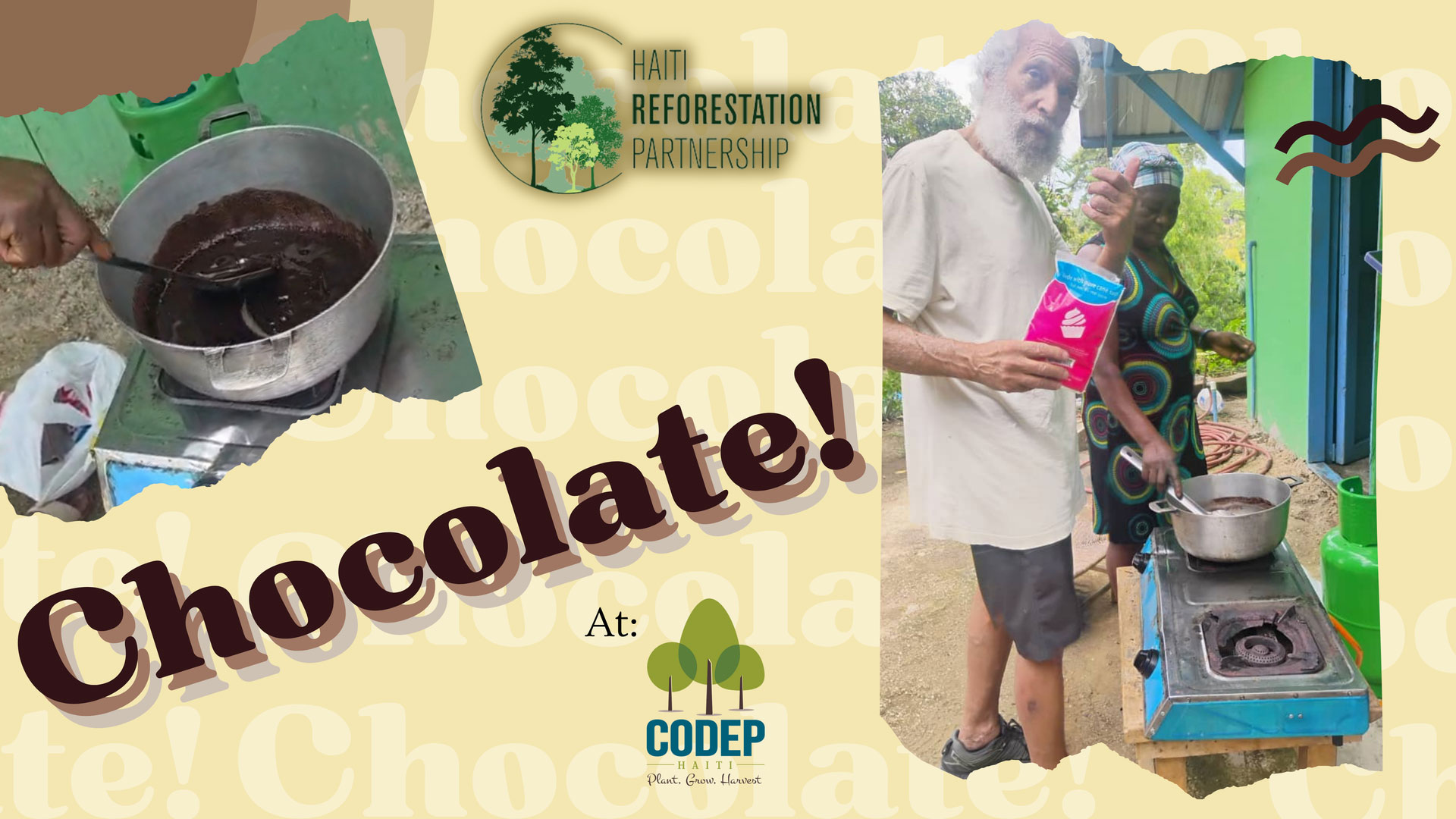
I spent part of a recent day in Haiti making chocolate bars.
Real chocolate. I mean starting with cacao pods from trees planted in CODEP zones, taking out the beans, roasting them, smashing them, grinding them, and cooking them until they could be shaped into chocolate balls.
Madame Enez was, of course, in charge.
I mostly tried to help without getting in the way.
The cacao pods came from trees that have been planted and cared for through CODEP’s work. That alone is worth stopping to think about. A tree planted in a zone does not only represent reforestation. It can also become food. It can become income. It can become a lesson because it can become a product.
That is exactly what we were trying to understand.
After the cacao beans were roasted and ground, they were formed into chocolate balls. Those alone can be sold. But then came the second experiment: could we turn those balls into chocolate bars?
We melted the chocolate balls and added powdered milk, sugar, and vanilla extract. At first, it did not look especially promising. The mixture was lumpy and stubborn, and I had my doubts. But after cooking and stirring for a while, it began to change. Slowly, it became smooth melted chocolate.
Then we poured it into silicone molds I had brought with me and put the molds in a refrigerator in Léogâne until the chocolate hardened.
The best part came when some of the Mentorship Program students came to taste the chocolate and give their opinions.
They took the job seriously.
They tasted, commented, compared and we all had a good time laughing. And in the middle of all of it, they were learning something important: what comes from the land can be transformed.
That may sound simple, but it is a big idea.
For years, we have talked about planting trees, protecting soil, growing gardens, and helping communities feed themselves. All of that remains at the center of HRP and CODEP’s work. But there is another step that matters too. When people learn how to add value to what they grow, the outcome changes.
Cacao pods become chocolate balls.
Chocolate balls become chocolate bars.
A crop becomes a product.
A product can become income.
This is the kind of practical education happening at CODEP. Students are not only learning about planting. They are learning how to think about what happens after planting. How do you harvest? How do you process? How do you improve? How do you sell? How do you turn local work into something that can support families and strengthen the community?
The first chocolate bars may not yet be ready for a storefront, but they were good. More importantly, they showed what is possible. Eventually, these bars could sell for around 250 gourde each. That matters.
The plan is to keep experimenting. Peanuts, mamba, and other products grown in CODEP zones could become part of this same effort. Each one offers another chance to teach, to test, and to build something useful from what is already growing.
This is how the work grows step by step.
From trees to food, to products, to income and then, from income to a more sustainable future for CODEP families.
This month we will be portraying trough our social media all the different efforts HRP is doing in terms of education so make sure to follow.
Your support helps make this kind of learning possible. It supports the trees, the gardens, the Mentorship Program, the training, and the small experiments that can lead to real opportunities.
Thank you for helping us plant more than trees.
With gratitude,
Michael Anello
Executive Director
Haiti Reforestation Partnership